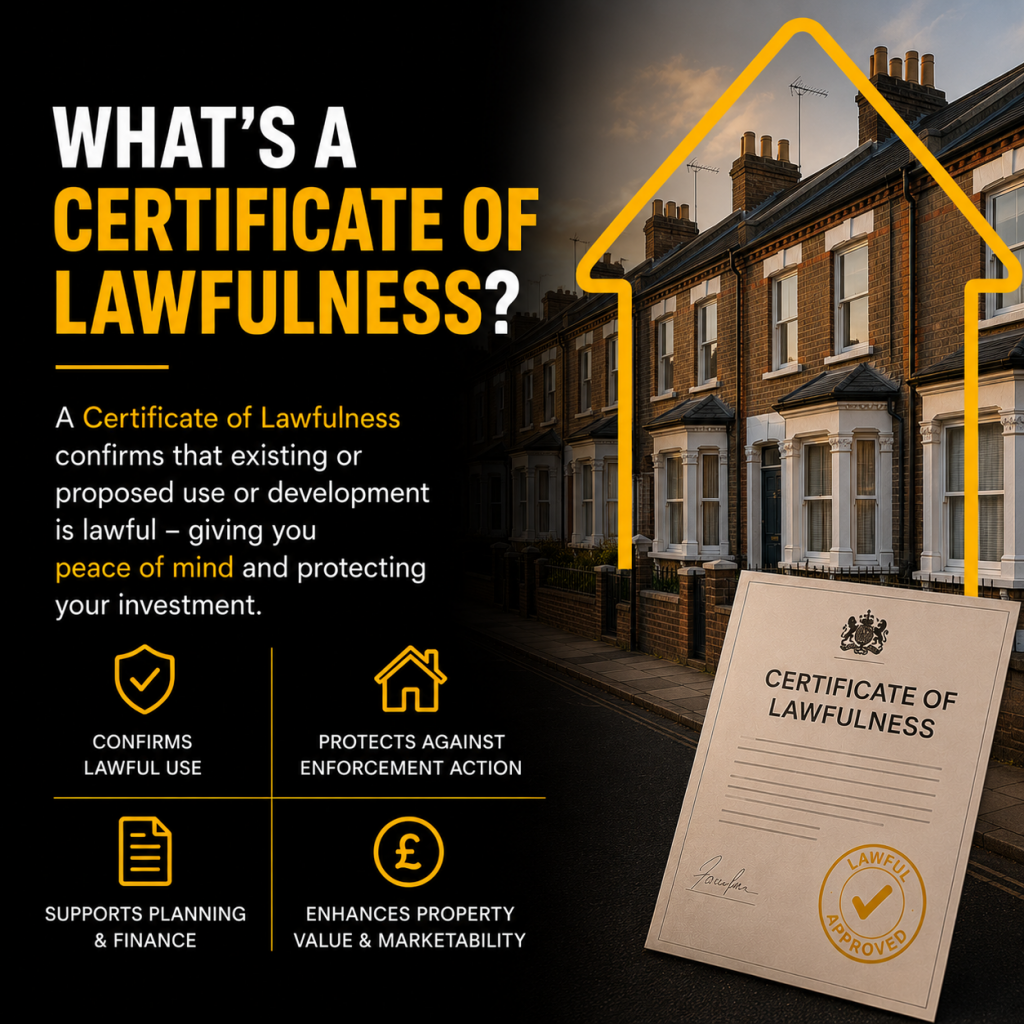
If you’re involved in property investment, development, or even simple home improvements, you may have come across the term Certificate of Lawfulness. It’s a crucial legal tool in the UK planning system—yet one that is often misunderstood.
In this blog post, we’ll explain what a Certificate of Lawfulness is, how it differs from planning permission, when you need one, and why it can significantly protect your property investment.
What Is a Certificate of Lawfulness?
A Certificate of Lawfulness (also known as a Lawful Development Certificate or LDC) is an official legal document issued by a local planning authority. It confirms that a specific use of land, building, or development is lawful under planning regulations. [propertypassport.uk]
Importantly, it does not grant planning permission. Instead, it confirms that:
- Planning permission is not required, or
- A development or use is already lawful (for example, due to the passage of time) [just-planning.co.uk]
Once granted, the certificate provides legal certainty, meaning the council cannot later take enforcement action against the development covered by it. [just-planning.co.uk]
The Two Types of Certificate of Lawfulness
There are two main types of Certificate of Lawfulness in the UK, each serving a different purpose:
1. Certificate of Lawfulness for Existing Use or Development (CLEUD)
This confirms that an existing property use or development is lawful.
You might apply for a CLEUD if:
- Work was completed without planning permission
- A property has been used in a certain way for many years
- You need to prove legality for selling or refinancing
In many cases, developments become lawful because the time limit for enforcement has expired. [propertypassport.uk]
2. Certificate of Lawfulness for Proposed Use or Development (CLOPUD)
This confirms that proposed works would be lawful before you start building.
It is commonly used when:
- You believe a project falls under permitted development rights
- You want formal confirmation before investing money
Once approved, the development is legally presumed to be lawful as long as it matches the approved plans. [gov.uk]
Certificate of Lawfulness vs Planning Permission
One of the most common misconceptions is that a Certificate of Lawfulness is the same as planning permission. They are very different.
Key Differences:
- Planning Permission
- Grants approval for new development
- Based on planning policies, design, and impact
- Forward-looking approval
- Certificate of Lawfulness
- Confirms something is already lawful or does not need permission
- Based purely on legal facts and evidence
- Does not assess design or suitability
In simple terms, planning permission gives you permission to build, while a Certificate of Lawfulness confirms you don’t need it. [lawshun.com]
When Do You Need a Certificate of Lawfulness?
A Certificate of Lawfulness is not always required, but it is highly recommended in certain situations.
Common scenarios include:
- Permitted Development Projects
Such as loft conversions, extensions, or garden rooms that fall within permitted development rules - Retrospective Legalisation
Where work has already been completed without planning permission - Property Sales or Remortgaging
Buyers and lenders often require proof that all works are lawful - Change of Use
For example, converting a property into an HMO or office space - Avoiding Enforcement Action
Especially when a development has existed for several years without challenge
It is typically used where there is uncertainty about whether planning permission is required. [lawshun.com]
Why a Certificate of Lawfulness Matters
Although applying for a certificate is optional, it offers several major benefits:
1. Legal Certainty
A Certificate of Lawfulness provides definitive proof that a development or use is lawful, giving peace of mind to property owners and investors. [harperlatt…ects.co.uk]
2. Protection from Enforcement
Once granted, the council cannot take enforcement action against the approved use or development. [just-planning.co.uk]
3. Improved Property Value
Having official documentation can make your property more attractive to buyers and lenders. [lawshun.com]
4. Reduced Risk in Property Transactions
Uncertainty about planning compliance can delay or even collapse property sales. A certificate removes this risk by providing clear evidence. [harperlatt…ects.co.uk]
How Is a Certificate of Lawfulness Assessed?
Unlike planning applications, a Certificate of Lawfulness is not based on opinion or planning policy.
Instead, the decision is based purely on:
- Legal rules
- Evidence
- Factual assessment
The council simply determines whether the development is lawful—not whether it should be allowed. [just-planning.co.uk]
Key Takeaways for Property Owners and Investors
- A Certificate of Lawfulness confirms legality—it does not grant permission
- It can apply to both existing and proposed developments
- It is essential for proving compliance, especially in property transactions
- Location, planning rights, and documentation all play a role in property value
Final Thoughts
Understanding what a Certificate of Lawfulness is can save you significant time, money, and risk when developing or managing property.
While it may seem like a technical legal document, it plays a vital role in ensuring your property is compliant, marketable, and protected. Whether you are building an extension, operating an HMO, or preparing to sell, obtaining this certificate can provide the clarity and certainty you need.