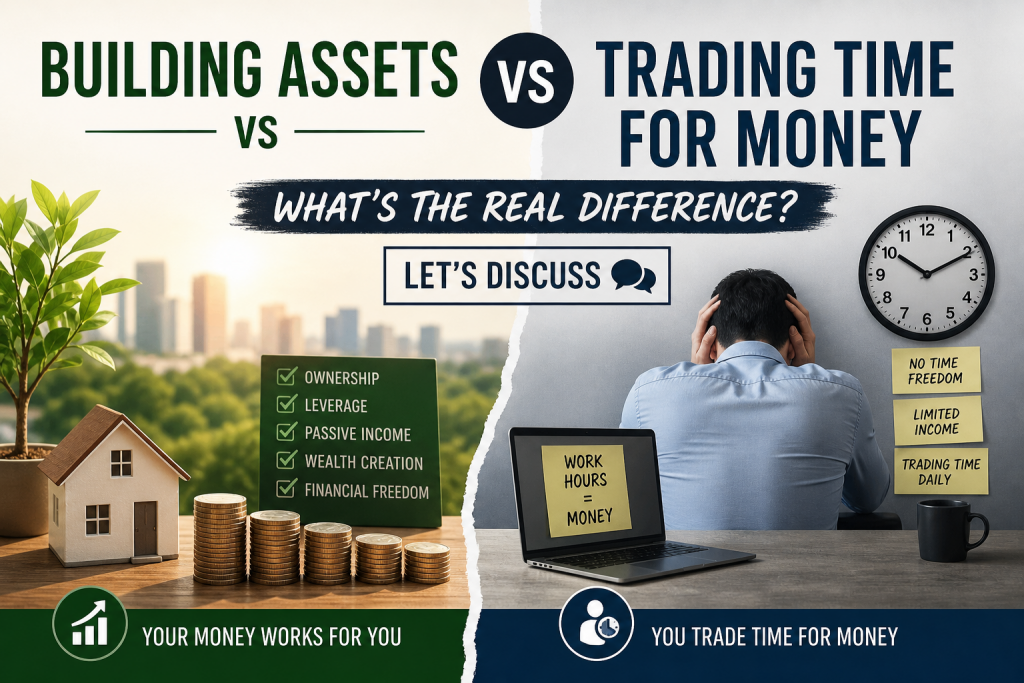
In today’s fast‑moving economy, more people are questioning the traditional way of earning a living. Should you continue trading your time for money, or should you focus on building assets that support your lifestyle? Understanding the difference between these two approaches is crucial if you want long‑term financial stability, freedom, and flexibility.
This blog post breaks down both models, explains their pros and cons, and helps you decide which path aligns best with your personal and financial goals.
What Does “Trading Time for Money” Mean?
Trading time for money is the most common way people earn an income. In simple terms, you exchange your hours, skills, or labour for a wage or salary.
Common examples include:
- Full‑time or part‑time employment
- Freelancing or consulting billed by the hour or project
- Overtime work
- Contract or gig‑based roles
Your income is directly linked to how much time you work. If you stop working, your income usually stops too.
The Advantages of Trading Time for Money
This model remains popular because it offers several short‑term benefits:
Predictable income
You know roughly what you’ll earn each week or month, which makes budgeting easier.
Lower upfront risk
Most jobs don’t require capital investment, making them accessible to almost everyone.
Fast cash flow
You’re paid quickly for your efforts, often weekly or monthly.
Clear structure
Defined roles, schedules, and expectations suit people who value stability and routine.
The Limitations of Trading Time for Money
While reliable, this approach has clear drawbacks over the long term:
Income is capped
There are only so many hours in a day. Your earning potential is limited by time and personal energy.
No work, no pay
Illness, holidays, burnout, or redundancy can instantly reduce or remove income.
Lifestyle dependence on work
Your standard of living relies entirely on continued effort.
Limited freedom
Location, schedule, and lifestyle choices often revolve around work commitments.
What Does “Building Assets to Support Your Lifestyle” Mean?
Building assets means creating or acquiring things that generate value or income without requiring constant hands‑on time from you.
These assets can work in the background, continuing to generate income even when you’re not actively working.
Common examples include:
- Investment portfolios (shares, ETFs, bonds)
- Property investments
- Online businesses
- Digital products (courses, ebooks, software)
- Content platforms (blogs, YouTube channels)
- Intellectual property
- Automated or systemised businesses
The key difference is leverage: once built, assets can keep producing results with minimal ongoing input.
The Advantages of Building Assets
Asset‑based income offers powerful long‑term benefits:
Income not tied to hours worked
Your earnings are not directly linked to time, allowing greater scalability.
Potential for passive or semi‑passive income
While no asset is truly “set and forget”, well‑built assets require far less daily involvement.
Greater lifestyle flexibility
Assets can support location independence, flexible schedules, and extended time off.
Wealth compounding
Assets can grow in value over time, not just generate income.
Resilience and diversification
Multiple assets can reduce financial risk if one income stream slows.
The Challenges of Building Assets
Despite the appeal, building assets isn’t easy or instant:
Delayed gratification
Most assets take months or years to become profitable.
Upfront effort or capital required
Time, money, learning, and experimentation are necessary before results appear.
Higher initial risk
Not all assets succeed. Some investments fail or underperform.
Ongoing strategy and maintenance
Assets still require management, reviews, and optimisation.
Lifestyle Impact: Active Income vs Asset Income
Trading time for money:
- Works well for short‑term needs
- Supports early‑stage careers
- Provides certainty but limits freedom
- Ties lifestyle directly to employment
Building assets:
- Focuses on long‑term sustainability
- Enables income without constant effort
- Requires patience and discipline
- Gradually decouples income from time
Many financially successful people don’t choose one or the other — they combine both.
Why Asset Building Is Often the Turning Point
The main reason people shift towards building assets is simple: time is finite.
As responsibilities grow — family, health, personal goals — relying solely on time‑based income becomes restrictive. Assets allow your money and systems to do some of the work for you.
This shift is often the difference between:
- Working to survive
- And building income that supports your desired lifestyle
A Hybrid Approach: The Best of Both Worlds
You don’t need to quit your job overnight to start building assets. In fact, many people use time‑based income to fund asset creation.
A sensible progression might look like:
- Trade time for money to cover living costs
- Allocate surplus income to asset building
- Grow assets alongside your primary income
- Gradually reduce reliance on time‑based work
This approach balances stability with long‑term freedom.
Which Path Is Right for You?
Ask yourself:
- Do you want predictable income now, or flexibility later?
- Are you willing to sacrifice short‑term comfort for long‑term gains?
- How much risk can you tolerate?
- What kind of lifestyle do you want in 5, 10, or 20 years?
There’s no universal answer. The right approach depends on your goals, risk tolerance, and stage of life.
Final Thoughts
Trading time for money offers security, clarity, and immediate results. Building assets offers leverage, freedom, and long‑term resilience. Understanding the difference allows you to make intentional decisions instead of default ones.
Over time, shifting even a portion of your effort from time‑based work to asset creation can radically change your financial future — and your lifestyle.