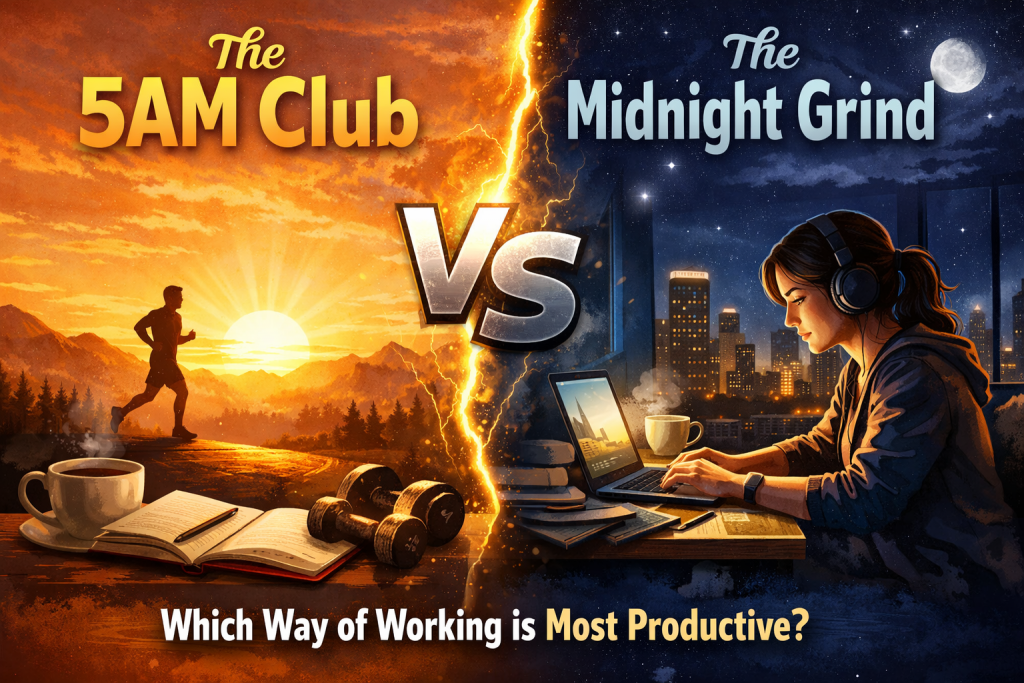
Few productivity debates spark as much passion as early mornings versus late‑night work. On one side, the 5am Club promises discipline, clarity, and a head start on the world. On the other, the Midnight Grind champions quiet focus, creativity, and working when everyone else has logged off.
But which approach is actually more productive? And is one objectively better than the other? In this blog post lets look at the two options.
The short answer: it depends on biology, lifestyle, and the type of work you do. Let’s break down the pros and cons of both approaches using psychology, sleep science, and real‑world productivity principles.
What Is the 5am Club?
The 5am Club refers to people who wake up extremely early to work, train, plan, or create before the rest of the world wakes up. The concept was popularised by productivity culture and high‑profile leaders, often linking early rising with success, discipline, and mental clarity.
Pros of the 5am Club
1. High focus and fewer distractions
Early mornings are typically free from emails, meetings, social media noise, and interruptions. This creates ideal conditions for deep, uninterrupted work.
2. Alignment with traditional work schedules
Morning‑focused individuals often perform better in environments with early meetings, school‑run responsibilities, and standard 9–5 expectations.
3. Strong routine and habit formation
Waking at the same early time reinforces structure and consistency, which are proven drivers of long‑term productivity.
4. Energy peak for morning chronotypes
Research on chronotypes shows that “morning types” reach peak alertness and cognitive performance earlier in the day, making mornings their most productive window.
Cons of the 5am Club
1. Not biologically suited for everyone
Chronotype research consistently shows that many people are not natural early risers. Forcing early wake‑ups can lead to sleep debt, reduced focus, and burnout over time.
2. Social and lifestyle constraints
Early bedtimes can clash with family life, social commitments, or creative work that happens later in the evening.
3. Productivity can decline later in the day
Early risers often experience energy crashes in the afternoon, making late‑day work less effective.
What Is the Midnight Grind?
The Midnight Grind describes people who do their best work late at night, often between 9pm and 2am. This approach is common among creatives, developers, entrepreneurs, and night‑owl professionals who thrive when the world goes quiet.
Pros of the Midnight Grind
1. Enhanced creativity and insight
Studies show that evening‑type individuals often perform better on creative and abstract thinking tasks later in the day.
2. Fewer interruptions and deeper immersion
Late nights offer uninterrupted blocks of time similar to early mornings, but without the pressure of an early start.
3. Natural alignment for night owls
Evening chronotypes reach peak cognitive performance later, meaning night work can feel effortless and energising rather than forced.
4. Ideal for global or asynchronous work
Late‑night workers often benefit when collaborating across time zones or working independently.
Cons of the Midnight Grind
1. Misalignment with society
Most work schedules, meetings, and deadlines are designed around daytime hours, which can disadvantage night workers.
2. Risk of sleep disruption
Staying up late without sufficient sleep has been linked to poorer mental health outcomes, especially when total sleep time drops below recommended levels.
3. Reduced morning performance
Night owls often struggle with early obligations, which can create friction in traditional work environments.
Productivity Science: Chronotypes Matter More Than the Clock
Modern sleep and productivity research increasingly agrees on one point:
working in alignment with your chronotype matters more than working early or late.
Chronotypes determine when your brain is naturally most alert, focused, and creative. Morning types tend to perform best early, while evening types peak later. Forcing the opposite schedule reduces performance rather than improving it.
Interestingly, large‑scale studies have found:
- Morning types often perform better in structured, exam‑based, or routine‑driven environments
- Evening types often show stronger performance in creative, problem‑solving, and cognitive flexibility tasks
Which Is More Productive: 5am or Midnight?
There is no universally superior schedule. Productivity depends on:
- Your natural chronotype
- Sleep quality and total sleep duration
- The type of work you do (analytical vs creative)
- Your environment and responsibilities
A well‑rested night owl will outperform a sleep‑deprived early riser, and vice versa.
The most productive people are not defined by when they work, but by:
- Consistency
- Adequate sleep
- Deep focus during peak energy hours
A Smarter Alternative: The Peak‑Hours Model
Instead of choosing sides, high performers increasingly adopt a peak‑hours approach:
- Identify your 3–5 most mentally sharp hours per day
- Schedule your most demanding work in that window
- Protect that time aggressively from distractions
For some, that’s 5am–9am.
For others, it’s 9pm–1am.
Final Verdict
The 5am Club and the Midnight Grind are not enemies — they are tools for different brains.
Early mornings reward discipline, structure, and routine.
Late nights reward creativity, immersion, and deep thinking.
The most productive schedule is the one that:
- Matches your biology
- Allows sufficient sleep
- Fits your lifestyle and work demands
Productivity is not about beating the clock — it’s about working with it.