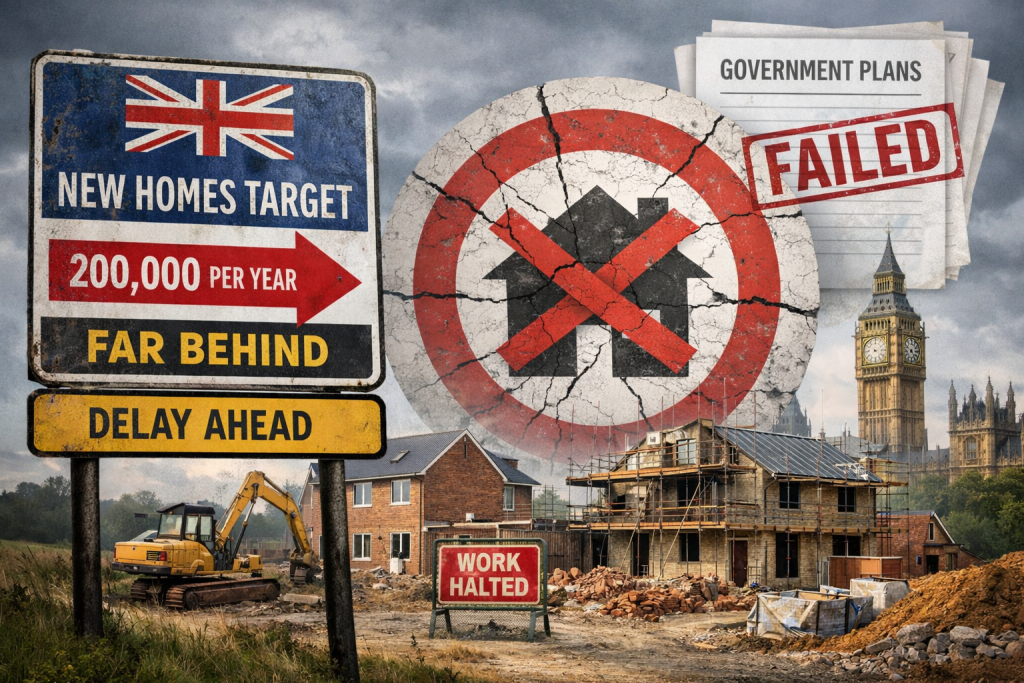
The UK housing shortage is no longer a looming problem – it is a full‑blown crisis. Across England, Scotland, Wales and Northern Ireland, demand for homes continues to outstrip supply, pushing prices higher, worsening affordability and locking millions of people out of the housing market. Despite repeated promises and headline‑grabbing targets, the UK government is getting nowhere near delivering the number of new homes needed each year.
This growing gap between ambition and reality is at the heart of the UK housing market’s ongoing dysfunction.
The scale of the UK housing shortage
The UK has spent decades under‑building homes. Population growth, smaller household sizes and changing living patterns have steadily increased demand, while new housing supply has failed to keep pace. The result is a structural shortage that affects renters, first‑time buyers and would‑be movers alike.
In many parts of the country, particularly in the South East and major cities, the lack of supply has driven house prices far beyond local wages. Private rents have risen sharply, social housing waiting lists continue to grow, and more people are forced to live in overcrowded or insecure accommodation.
This is not a short‑term market wobble. It is a long‑term supply failure.
The government’s annual new homes target
Successive UK governments have acknowledged the problem and set ambitious housebuilding targets. The most commonly cited benchmark is around 300,000 new homes per year in England, a figure intended to both meet new demand and begin chipping away at the historic backlog.
On paper, the target sounds bold. In practice, delivery has consistently fallen well short.
Even in stronger market years, completions have struggled to approach the level required. In weaker economic conditions, output falls further as developers slow building in response to higher interest rates, rising costs and weaker buyer demand.
The gap between the number of homes promised and the number actually built continues to widen.
Why the UK is missing its housing targets?
There is no single reason the UK government is failing to hit its annual new homes target. Instead, a combination of structural, economic and political factors continues to hold back delivery.
Planning constraints remain one of the biggest obstacles. The planning system is slow, complex and unpredictable, with major delays at local authority level. Even when planning permission is granted, a significant proportion of approved sites never progress to construction.
Viability is another major issue. Rising land prices, higher build costs, labour shortages and increased regulatory requirements have made many schemes financially marginal. In some areas, it simply does not stack up to build at scale without public subsidy or support.
The private housing market also plays a limiting role. Most new homes in the UK are built by private developers who sell into the open market. When mortgage rates rise or buyer confidence falls, build‑out rates slow, regardless of government targets.
Social and affordable housing has suffered decades of underinvestment, leaving housing associations and councils without the funding needed to build at the scale required to compensate for private sector slowdowns.
Political uncertainty and frequent policy changes only add to the problem. Shifts in planning rules, housing targets and funding priorities create risk and delay, discouraging long‑term investment.
The real‑world impact on the UK housing market
Failing to meet new homes targets has serious consequences for the wider economy and society. High housing costs reduce disposable income, limit labour mobility and make it harder for businesses to recruit. Younger generations face delayed home ownership, while older homeowners benefit from rising prices, deepening inequality.
In the rental market, limited supply fuels higher rents and greater insecurity. In the social sector, the shortage contributes to longer waiting lists and rising homelessness pressures on local authorities.
These impacts are not evenly distributed. Areas with the strongest job markets often have the most acute housing shortages, creating a damaging mismatch between where homes are needed and where they are delivered.
Why building more homes isn’t enough on its own
While increasing supply is essential, simply setting targets is not enough. The UK housing market needs the right homes, in the right places, at prices people can afford.
Too many new developments are built in low‑demand areas with poor transport links and limited access to jobs. Meanwhile, high‑demand urban areas struggle to deliver enough homes due to planning resistance and infrastructure constraints.
Without addressing these underlying issues, even an increase in headline housing numbers would fall short of solving the crisis.
What needs to change?
If the UK is serious about tackling the housing shortage, more fundamental reform is required. That includes faster and more predictable planning decisions, sustained investment in social and affordable housing, and policies that support building through economic downturns rather than amplifying cycles.
Crucially, success should be measured by homes actually built and lived in, not by announcements, targets or permissions granted.
Until then, the gap between the government’s housing ambitions and the reality on the ground will continue to grow.
In conclusion the UK housing shortage is one of the defining challenges of our time. While government targets recognise the scale of the problem, delivery remains far below what is needed. Without meaningful reform and long‑term commitment, the annual new homes target will remain exactly that – a target, not an achievement.