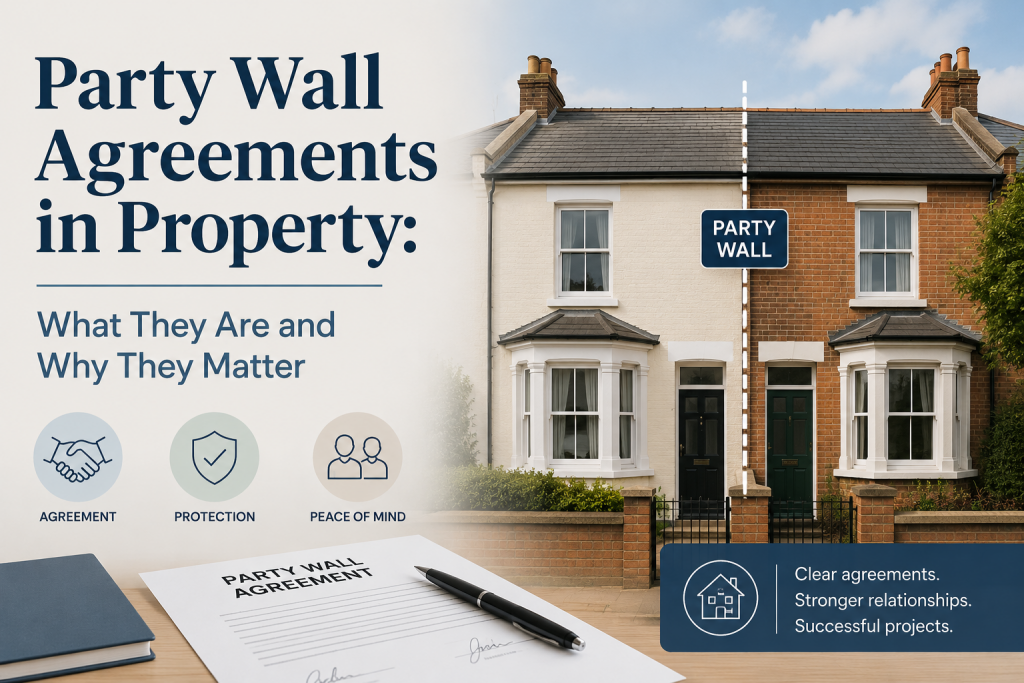
When developing or renovating property in England and Wales, one legal requirement often overlooked is the party wall agreement. Whether you’re planning a loft conversion, basement excavation or building an extension, understanding how party wall matters work can save you time, money and disputes with neighbours. In this blog post, we break down what party wall agreements are, when they apply and why they are so important in property development.
What Is a Party Wall Agreement?
A party wall agreement is a formal arrangement between property owners whose buildings share a common boundary or structural element. It stems from the Party Wall etc. Act 1996, which sets out the legal framework for carrying out certain types of building work near or on a shared wall or boundary.
A “party wall” can include:
- A wall that stands on the boundary between two properties
- A wall that is part of one building but sits on the boundary line
- Floors or ceilings between flats (party structures)
- Garden walls built astride a boundary
The agreement itself usually arises after one property owner (the building owner) serves a formal party wall notice on the neighbouring property owner (the adjoining owner) before starting work.
When Do You Need a Party Wall Agreement?
You will typically need a party wall agreement if your planned works fall into specific categories under the Act, including:
- Cutting into a party wall (for example, to insert steel beams)
- Raising or lowering a party wall
- Demolishing and rebuilding a shared wall
- Excavating near a neighbouring building (often within 3 or 6 metres, depending on depth)
- Building a new wall on or at the boundary line
If any of these apply, you are legally required to notify your neighbour in advance. Failure to do so can lead to delays or legal action.
The Process Explained
Understanding the party wall process helps prevent misunderstandings and keeps your project on track:
- Serve Notice
The building owner must give written notice to affected neighbours, typically at least one or two months before starting work, depending on the type of works. - Neighbour’s Response
The adjoining owner can:- Agree to the works
- Request modifications
- Refuse consent, triggering a dispute
- Appointment of Surveyors
If there is a dispute or no response, one or two party wall surveyors are appointed to act impartially. - Party Wall Award
The surveyor(s) issue a legally binding document outlining how and when the works should be carried out, including measures to protect the adjoining property.
Why Party Wall Agreements Are Important
1. Legal Compliance
The Party Wall Act is not optional. Failing to follow it can result in legal injunctions stopping your work, costly delays or even compensation claims. A party wall agreement ensures your project complies with the law.
2. Protecting Neighbour Relationships
Construction work can be disruptive. Serving notice and agreeing terms beforehand helps maintain good relations with neighbours, reducing the risk of disputes escal or complaints.
3. Protecting Properties
Party wall surveys often include a schedule of condition, documenting the state of neighbouring properties before work begins. This protects both parties by clearly identifying any pre-existing damage.
4. Avoiding Costly Disputes
Without a formal agreement, disagreements about damage, noise or access can escalate quickly. A party wall award provides a structured way to resolve issues before they arise.
5. Enabling Smooth Project Delivery
Developers and contractors rely on certainty. Having a party wall agreement in place ensures there are no unexpected legal interruptions once the work has begun.
Common Misunderstandings About Party Wall Agreements
- “It only applies to shared walls”
In fact, excavation near neighbouring buildings can also trigger the Act. - “Planning permission replaces it”
Planning approval does not override party wall requirements—they are separate processes. - “My neighbour can stop the work completely”
Neighbours cannot unreasonably block lawful work, but they can ensure proper safeguards are in place.
Tips for Property Developers
To handle party wall matters effectively, consider the following best practices:
- Plan early – Factor party wall timelines into your project schedule
- Communicate clearly – Inform neighbours early to avoid surprises
- Hire experienced surveyors – Professional guidance can prevent costly mistakes
- Keep documentation organised – Ensure all notices and agreements are properly recorded
Final Thoughts
Party wall agreements are a crucial element of property development that should never be overlooked. They provide a legal safeguard, protect neighbouring properties and ensure construction work proceeds smoothly. By understanding your obligations under the Party Wall etc. Act 1996 and taking proactive steps to comply, you can avoid disputes and keep your development project on track.
If you are planning any building work near a shared boundary, it’s always wise to seek professional advice early to ensure compliance and peace of mind.