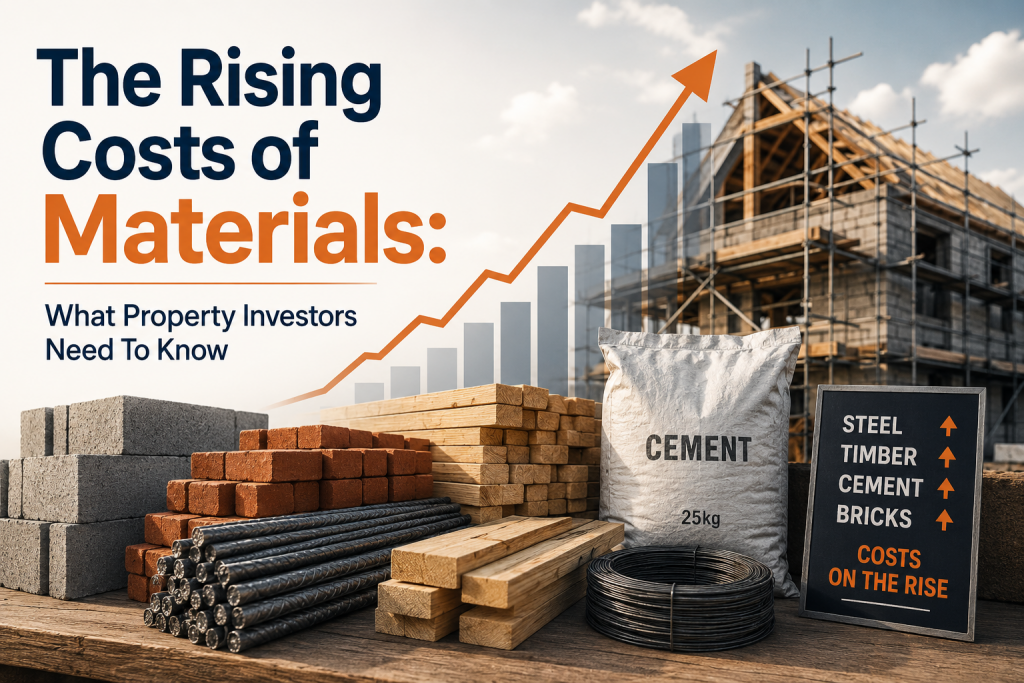
Over the past five years, property developers and investors across the UK have faced a sharp and sustained rise in construction material costs. From steel and timber to concrete and energy inputs, price volatility has fundamentally changed the economics of development projects—tightening margins, delaying timelines, and increasing risk.
In this blog post, we explore what’s driven these cost increases and outline practical strategies savvy investors can use to protect profitability in today’s challenging market.
Why Construction Material Costs Have Risen So Sharply
1. Post-Pandemic Supply Chain Disruption
The COVID-19 pandemic created widespread disruption to global supply chains, affecting the availability of key materials such as timber, steel, and cement. Shortages, shipping delays, and higher logistics costs caused prices to surge and remain elevated in the years that followed. [ukfinance.org.uk], [moorgatefinance.com]
Even as supply chains stabilised, materials have settled at a higher baseline cost rather than returning to pre-2020 levels. [atkinsrealis.com]
2. Inflation and Volatility in Key Materials
Inflation has played a major role in driving up construction costs globally. Prices for essential materials—including steel, lumber, and electrical components—have fluctuated significantly due to changing supply-demand dynamics and geopolitical factors. [mastt.com]
Between 2020 and recent years, some construction materials experienced dramatic increases, with steel and petroleum-based products showing particularly high volatility and long-term price growth. [constructi…owners.com]
3. Labour Shortages and Wage Inflation
The UK construction sector continues to struggle with a shortage of skilled labour, partly due to Brexit and an ageing workforce. This shortage has driven up wages, adding further pressure on overall development costs. [ukfinance.org.uk]
Labour cost increases are now a major driver of construction price escalation alongside materials. [bcis.co.uk]
4. Geopolitical Tensions and Energy Prices
Global events—from the war in Ukraine to Middle East tensions—have increased fuel and energy costs, which directly impact material production and transportation. As a result, construction firms have experienced some of the steepest cost increases in decades. [theguardian.com]
5. Regulatory Changes and Sustainability Requirements
New building regulations, particularly around energy efficiency and safety, have increased demand for higher-specification materials and technologies. While these changes improve long-term asset value, they also increase upfront construction costs. [ukfinance.org.uk]
The Impact on Property Development
The result of these combined pressures is a significant increase in build costs. Industry estimates suggest construction costs have risen by roughly 15–20% since 2020, with ongoing volatility creating uncertainty for developers. [ukfinance.org.uk], [moorgatefinance.com]
For property investors, this has led to:
- Reduced profit margins
- Delayed project timelines
- Increased financing requirements
- Greater risk exposure
As costs rise faster than property values in some markets, traditional development models are being challenged.
How Savvy Investors Are Mitigating Cost Increases
Despite these challenges, experienced investors are adapting. Here are proven strategies to protect returns and manage rising build costs.
1. Lock in Prices Early Through Strategic Procurement
Forward purchasing and long-term supplier agreements can help stabilise costs in a volatile market. By securing materials early, developers reduce exposure to future price increases. [moorgatefinance.com]
Bulk buying and supplier partnerships also improve negotiating power and pricing certainty. [investwithcarl.com]
2. Embrace Modern Construction Methods
Offsite and modular construction techniques are becoming increasingly popular as a way to cut costs and improve efficiency.
Benefits include:
- Reduced labour requirements
- Faster build times
- Lower waste levels
These methods can significantly improve cost predictability and reduce overall project risk. [ukfinance.org.uk]
3. Use Technology for Smarter Planning
Tools such as Building Information Modelling (BIM) enable developers to identify inefficiencies before construction begins. This reduces costly errors, rework, and material waste. [ukfinance.org.uk]
Advanced analytics and digital cost control systems are also helping investors track budgets in real time and respond quickly to changes. [investwithcarl.com]
4. Diversify Supply Chains and Materials
Relying on a single supplier or region increases risk. Savvy investors are diversifying supply chains and exploring alternative materials that offer similar performance at lower cost. [civilengin…topics.com]
Using innovative or sustainable materials can also align with regulatory trends while optimising costs.
5. Build Contingencies into Financial Models
Given ongoing volatility, experienced developers are factoring inflation into their budgets and including contingency allowances to protect against cost overruns. [civilengin…topics.com]
Flexible financing structures and risk-sharing agreements can further reduce exposure. [investwithcarl.com]
6. Focus on Speed and Efficiency
Time is a major cost driver in development. Delays increase labour costs, financing costs, and overheads.
By:
- Accelerating project timelines
- Improving site coordination
- Reducing rework
Investors can significantly improve project profitability. [vision-con…uctors.com]
7. Prioritise Value Engineering
Rather than simply cutting costs, smart developers focus on “value engineering”—achieving the same outcome at a lower cost through better design, materials, and processes. [vision-con…uctors.com]
This ensures long-term asset quality isn’t sacrificed for short-term savings.
Key Takeaways for Property Investors
The past five years have reshaped the property development landscape. Rising material costs are no longer a temporary issue—they are a structural challenge that investors must actively manage.
To stay competitive, investors should:
- Take a proactive approach to procurement
- Integrate technology and data-driven planning
- Embrace modern construction methods
- Build flexible, resilient financial models
Final Thoughts
While rising construction costs have created new challenges, they have also rewarded those who adapt quickly. Investors who understand the drivers behind material inflation—and implement smart mitigation strategies—can still achieve strong returns in today’s market.
In an environment defined by volatility, success in property development increasingly comes down to one thing: strategic cost control combined with smart, forward-thinking decision-making.