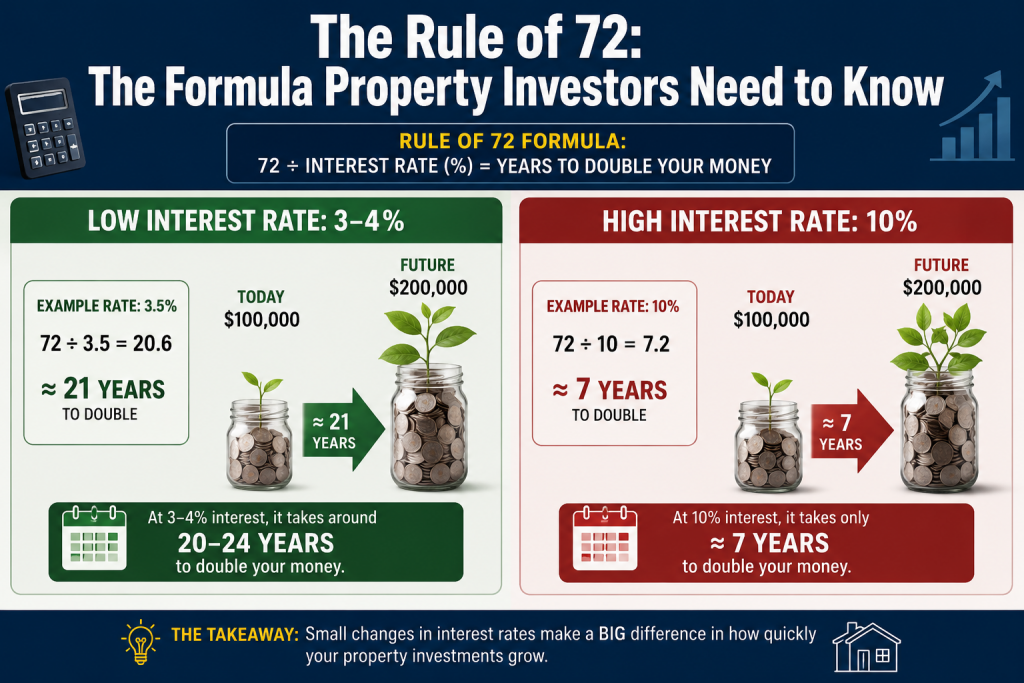
If you want to become a smarter investor, few principles are as powerful — or as simple — as the Rule of 72. This straightforward formula helps you quickly estimate how long it takes for your money to double, giving you instant clarity on the impact of different interest rates.
In this blog post, we’ll break down the fundamentals of the Rule of 72, show practical examples using typical bank rates (3–4%), and compare them with higher-yield opportunities around 10% — a level often seen in our private investment deals.
What Is the Rule of 72?
The Rule of 72 is a mental shortcut used to estimate how long it will take an investment to double based on its annual return. The formula is simple:
Years to double = 72 ÷ annual interest rate (%) [sofi.com]
For example:
- At 6% return → 72 ÷ 6 = 12 years to double
- At 10% return → 72 ÷ 10 = 7.2 years to double [wealthvieu.com]
This rule works because of compound interest, where your returns generate additional returns over time — often described as “interest on interest”. [cnbc.com]
Why the Rule of 72 Matters for Investors
The Rule of 72 transforms abstract percentages into something much more tangible: time.
Instead of thinking:
- “This investment earns 4%”
You can think:
- “This investment takes around 18 years to double”
This shift helps investors:
- Compare opportunities quickly
- Set realistic expectations
- Understand the power of compounding
- Avoid low-growth traps
Example 1: Traditional Bank Interest (3–4%)
Let’s start with a typical savings scenario.
At 3% Interest
- 72 ÷ 3 = 24 years to double [percentage…ator.co.uk]
At 4% Interest
- 72 ÷ 4 = 18 years to double [percentage…ator.co.uk]
What This Means in Practice
If you invested £50,000:
- At 3% → £100,000 in ~24 years
- At 4% → £100,000 in ~18 years
While these rates are relatively stable and low-risk, they come with a major trade-off: time. Your capital grows slowly, and inflation can erode purchasing power over long periods.
Example 2: Higher-Yield Investing (10%)
Now compare that to a 10% return.
At 10% Interest
- 72 ÷ 10 = 7.2 years to double [wealthvieu.com]
What This Means in Practice
Using the same £50,000 investment:
- ~£100,000 in 7.2 years
- ~£200,000 in 14.4 years
- ~£400,000 in 21.6 years
This demonstrates the exponential effect of compounding — higher returns dramatically shorten the time needed to build meaningful wealth.
Side-by-Side Comparison
| Interest Rate | Years to Double | Key Insight |
|---|---|---|
| 3% | 24 years | Slow growth, capital preservation |
| 4% | 18 years | Slightly better, still long-term |
| 10% | 7.2 years | Accelerated wealth building |
As you can see, the difference between 4% and 10% isn’t just “6% more” — it’s a 2–3x faster path to doubling your money.
The Real Power: Multiple Doublings
The Rule of 72 becomes even more powerful when you consider multiple doubling cycles.
At 3%:
- 1 doubling (24 years): £50k → £100k
- 2 doublings (48 years): £50k → £200k
At 10%:
- 1 doubling (7.2 years): £50k → £100k
- 2 doublings (14.4 years): £50k → £200k
- 3 doublings (21.6 years): £50k → £400k
This is the core principle of wealth creation: time + higher returns = exponential growth.
Key Takeaways for Investors
1. Small Rate Differences Create Massive Outcomes
A few percentage points can mean decades of difference in reaching financial goals.
2. Compounding Rewards Patience — But Also Performance
Time in the market matters, but so does the rate of return.
3. Low Rates Protect, High Rates Grow
- Lower rates (3–4%) are often safer and more liquid
- Higher rates (around 10%) can significantly accelerate growth
4. The Rule of 72 Helps You Think Strategically
It allows you to:
- Evaluate deals quickly
- Understand long-term impact instantly
- Make better capital allocation decisions
Limitations to Be Aware Of
While incredibly useful, the Rule of 72 is an approximation:
- It works best for rates between 6% and 10% [sofi.com]
- It assumes a consistent rate of return
- It doesn’t account for taxes, fees, or inflation
However, as a quick decision-making tool, it remains one of the most effective formulas in investing.
Final Thoughts
The Rule of 72 is more than just a formula — it’s a mindset shift.
It forces you to stop thinking in percentages and start thinking in time and outcomes.
When you compare:
- 24 years at 3%
vs - just over 7 years at 10%
…it becomes clear why experienced investors prioritise opportunities that deliver stronger returns where appropriate.
Ultimately, the question every investor should ask is:
“How quickly do I want my money working for me?”
Use the Rule of 72, and you’ll always have the answer.