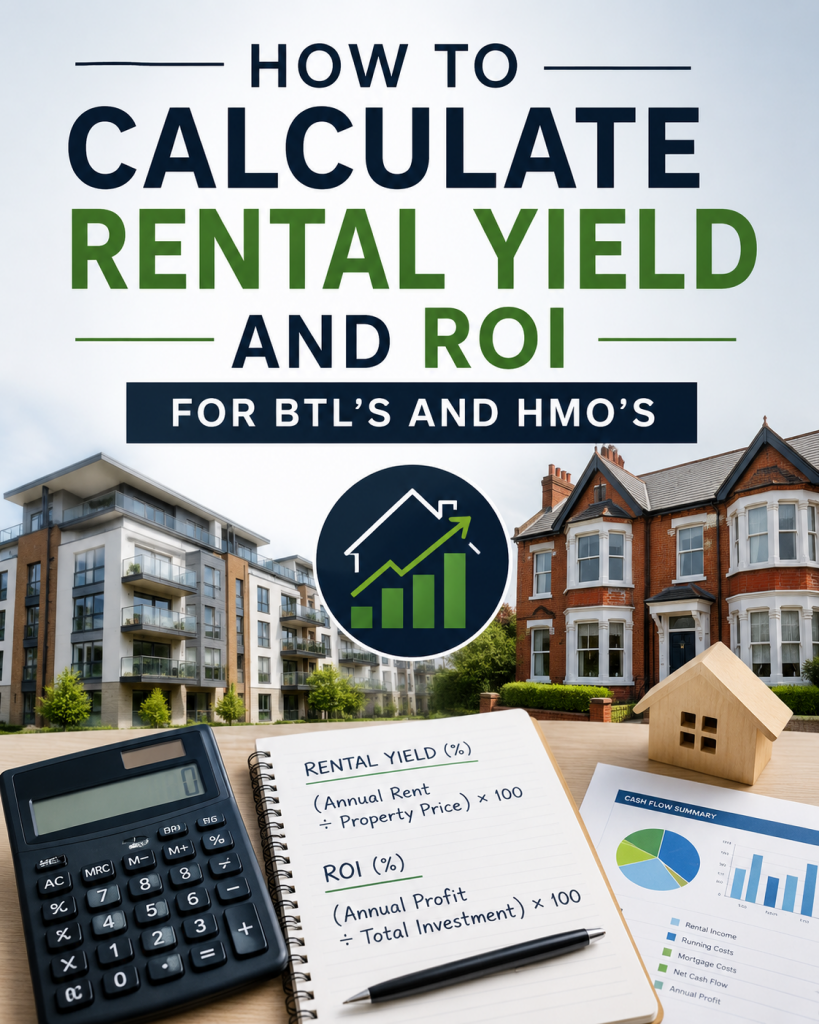
If you’re investing in UK property, understanding how to calculate rental yield and return on investment (ROI) is essential. These two metrics help you compare deals, forecast profits, and avoid costly mistakes.
In this blog post, we explain the exact formulas used by investors, plus real-world examples for both buy-to-let (BTL) and HMO (House in Multiple Occupation) properties.
What Is Rental Yield?
Rental yield measures how much income a property generates compared to its value. It’s usually expressed as a percentage and is the first metric most investors look at. [ukcalculator.com]
There are two key types:
- Gross yield – quick comparison tool
- Net yield – more realistic indicator of performance
How to Calculate Gross Yield
Gross yield is the simplest calculation:
Gross Yield = (Annual Rental Income ÷ Property Value) × 100 [ukcalculator.com]
Example: Standard Buy-to-Let (BTL)
- Purchase price: £200,000
- Monthly rent: £1,000
- Annual rent: £12,000
Gross Yield = (£12,000 ÷ £200,000) × 100 = 6% [landlordguru.co.uk]
This gives you a quick snapshot, but it ignores all costs.
How to Calculate Net Yield
Net yield accounts for operating expenses, giving a much clearer picture of profitability.
Net Yield = ((Annual Rent − Annual Costs) ÷ Property Value) × 100 [ukcalculator.com]
Typical costs include:
- Letting agent fees
- Maintenance and repairs
- Insurance
- Void periods
- Safety and compliance costs [landlordguru.co.uk]
Example: BTL Net Yield
Using the same property:
- Annual rent: £12,000
- Annual costs: £3,600
- Net income: £8,400
Net Yield = (£8,400 ÷ £200,000) × 100 = 4.2% [landlordguru.co.uk]
This shows how costs significantly reduce your actual return.
What Is Return on Investment (ROI)?
ROI measures how much profit you make relative to the cash you’ve invested.
ROI Formula: (Net Annual Profit ÷ Total Cash Invested) × 100 [indexproperty.co.uk]
Unlike yield, ROI includes:
- Deposit
- Stamp duty
- Legal fees
- Refurbishment costs
- Mortgage interest and finance costs [indexproperty.co.uk]
This makes ROI the most accurate way to assess performance.
BTL ROI Example
Let’s build on the earlier BTL example.
Investment details
- Purchase price: £200,000
- Deposit (25%): £50,000
- Stamp duty + fees: £10,000
- Total cash invested: £60,000
Annual figures
- Rent: £12,000
- Costs (including mortgage): £9,000
- Net annual profit: £3,000
ROI calculation
ROI = (£3,000 ÷ £60,000) × 100 = 5%
This shows your actual return on cash—not just property value.
HMO Yield Explained
HMOs typically generate higher rental income because multiple tenants pay rent per room. [property-f…lter.co.uk]
However, they also come with higher costs, including:
- Utilities (often included in rent)
- Council tax
- Higher management fees
- Licensing costs [property-f…lter.co.uk]
HMO Yield Example
Property details
- Purchase price: £220,000
- 5 rooms at £600/month each
- Annual rent: £36,000
Gross yield
Gross Yield = (£36,000 ÷ £220,000) × 100 = 16.4% [property-f…lter.co.uk]
Net yield (after costs and voids)
- Adjusted rent (voids): £34,200
- Annual costs: £11,000
- Net income: £23,200
Net Yield = (£23,200 ÷ £220,000) × 100 = 10.5% [property-f…lter.co.uk]
This highlights the difference between headline figures and real returns.
HMO ROI Example
Investment overview
- Purchase: £220,000
- Refurbishment + setup: £30,000
- Fees and stamp duty: £15,000
- Total cash invested: £65,000
Annual performance
- Net income after all costs (including finance): £12,000
ROI calculation
ROI = (£12,000 ÷ £65,000) × 100 = 18.5%
This is why HMOs are popular—they often deliver stronger ROI, despite higher complexity.
Key Differences: Yield vs ROI
Understanding the difference is crucial:
- Yield compares rent to property value
- ROI compares profit to your actual cash invested [dmnproperty.com]
In simple terms:
- Yield tells you how good the deal looks
- ROI tells you how hard your money works
Common Mistakes to Avoid
Many landlords make errors when calculating returns:
- Relying on gross yield only
- Ignoring void periods
- Underestimating maintenance costs
- Forgetting setup costs in ROI
These mistakes can significantly overstate profitability.
Final Thoughts
To properly assess any property deal:
- Start with gross yield to compare options
- Use net yield to understand true performance
- Calculate ROI to evaluate your actual return
BTL properties tend to be simpler and lower risk, while HMOs offer higher yields and ROI—but require more management and careful cost control.